
Follow Future Movies on Twitter
Online DVD Rental

Cabin Fever Movie Review

Cabin Fever

Cabin Fever, by producer/director Eli Roth, is a funny film that was obviously quite enjoyable to make. Its only problem is that it is supposed to be for horror fans, but isn’t actually that frightening. Gory it may be, but scary it is not.

The main reason why Cabin Fever is funny in parts but not particularly fear-inducing in others is because it’s not really sure what it wants to be. Roth throws a variety of elements into the mix with a certain joyous abandon, but he works better when he has fun with the genres he is plundering than when he tries to use them for serious intent.

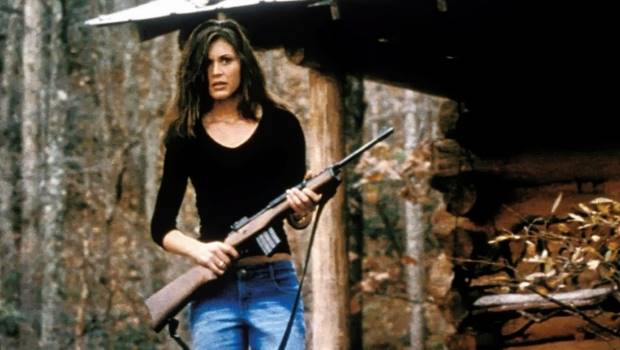
Cabin Fever follows a group of students (or, if you’d, like cheap actors) as they mark the end of their exams by taking a well-deserved mini-break. Not, as you might expect, to somewhere warm and populated. No, these crazy kids, who have clearly never been to the movies in their lives, decide to spend a relaxing couple of days in a cabin, in the middle of the woods, in nowheresville America. If this group of dumb Yanks were not already aware of the inherent dangers of such an enterprise, then they really should have realised their plan was a little foolish when they stop off to get supplies and one of the group gets bitten by a harmless looking child. And is then blamed by the child’s redneck father for getting bitten. Whose own kindly-looking father refers to black people as ‘niggers’.

Despite the fact that their surroundings are essentially shouting, ‘squeal little piggy, squeal!’, this bumbling group of idiots think nothing of the incident and carry on regardless to the cabin of their dreams, which looks like every wooden structure used in every horror film ever. But a little less inviting. To begin with, everything goes smoothly. Two of the group have rampant sex, thereby allowing the token glamour actress to exhibit the amount of money she spent getting her tits done, whilst, bizarrely enough, shoving her finger up her boyfriend’s ass. The other potential couple in the group would have sex if it was up to the boy, but instead they just have a quick pet on a raft in the middle of the lake that they have somehow managed to reach (clearly they are Olympic swimmers). The final member of the group decides to shoot squirrels, ‘because they’re gay’. (When challenged on his homophobia, he says, ‘C’mon – I don’t care if they’re gay or straight. I’ll shoot them anyway!’.)

Problems arise when the squirrel-destroyer accidentally shoots a man whom he understandably mistakes for a squirrel. To make matters worse, the man seems to be suffering from a rather unfortunate disease. It doesn’t turn him into a murderous ball of rage as you might expect from a horror film, but it does have the unpleasant by-product of making him bruise like a peach until his skin falls off quicker than Jordan’s brassiere.

Instead of heading back to the cabin, rounding up his friends and suggest that maybe they’d like to leave the woods, numb nuts decides to head back to the cabin as if nothing has happened. That night he looks genuinely surprised when the man he shot earlier, who could really do with some skin cream, turns up at the cabin and asks for some help. Again, rather making a sensible decision, the students, who must attend the worst academic institution in the world, decide to make flaky-skin-man’s life easier by beating the living crap out of him. Whilst he is sitting in their car. The man returns their kindness by puking up blood. So the kids set fire to him and happily watch him scream like a banshee and hotfoot it through the forest, as he suffers the double blow of hot and flaky skin.

Here on in, things take a turn for the worse. Not only do the kids feel a tad guilty for burning alive the poor shmuck, but also the damage they have caused to their car’s bodywork somehow stops it from working. Oh, and the guy who they burnt handily made it to the local reservoir, thereby infecting the local water supply. But the kids don’t know this. So they drink the water. And one by one, they each get infected.

This infection is Roth’s greatest strength and biggest downfall. It does lead to some pretty gruesome scenes, the standout being when one of the boys finally gets his wicked way with the girl of his dreams and reaches third base, only to find that she is suffering from what looks like the heaviest period in the world. But when the kids get infected, nothing really happens. They don’t go berserk and try and kill each other in a variety of ingenious ways. They just find that their skin comes off and they start puking blood. Which causes Cabin Fever to be no scarier than an episode of Casualty with a bigger special effects budget than usual.

When the locals, led by the father of the hand-biting boy, realise something has gone awry in the woods, they decide to display some regional hospitality and kindness to the kids by hunting them down like dogs. Unfortunately, Roth’s foray into Deliverance territory is his second greatest strength but again his second biggest downfall. Roth's homicidal rednecks are undoubtedly amusing - the hand-biting (and as it turns out) kung-fu fighting kid; a very large but soft-in-the- head yokel who does nothing but carry a small wooden box; and, best of all, a young party-loving deputy whose ability to do his job is as inept as the bum-fluff he calls a moustache - but they are about as frightening as Grandma Walton.

The fact that Roth hadn’t really decided what film he wanted to make before he started rolling, does give Cabin Fever a funky guerrilla film-making feel and allows for some pretty whacky scenes (such as when the glamour girl, dressed up to the nines, leaves the cabin claiming she is going to get help and is next seen gliding serenely across a lake in a large Indian canoe). Roth should also be commended for making a film that doesn’t take itself too seriously. Yet by the same token this causes Cabin Fever to become too loose and unfocused, unsure of itself and what it really wants to be. Any tension that does manage to get created along the way is completely lost in an interminable ending which lays bare Cabin Fever’s lack of structure and cohesion.

The fact that Cabin Fever winds down with one of the funniest stand-out scenes to reach our screens in the past couple of years is potentially worth the price of a ticket stub alone, but horror aficionados might leave cinemas disappointed. It’ll be interesting to see what Roth comes up with next, but in the meantime, you can probably save save your dosh and rent the DVD for a schlock-horror night in, maybe as a nice antidote to the much better-made but slightly less-fun 28 Days Later.

Press release: Director Eli Roth
Director Eli Roth talks about his film Cabin Fever: "I have been a horror movie fanatic for as long as I can remember. Films like Sam Raimi’s “The Evil Dead,” John Carpenter’s “The Thing,” and Wes Craven’s “A Nightmare on Elm Street” were made with uncompromising terror, and pushed my childhood imagination into dark corners I never knew existed. I aspired to make a horror film that would have a resonating scare, one that would stay with the audience long after they left the theater.

Somewhere around the mid-80’s, my favorite horror directors “graduated” into big studio movies, the new horror films were made with less care and craft, and the genre that once fueled the movie industry came to a grinding halt. At the end of the 1970’s horror films were written around the basic premise: what is horrifying? By the end of the 1980’s, horror films were written around the premise: how can we kill this group of kids?

I set out to make a film that would be a throwback to the late 70’s/early 80’s heyday of horror. This would not be a comedy – it would be a straight scary movie, one that would use humor to both release tension and draw people into the film. I hope I have succeeded, and that audiences have as much fun watching the film as we had making it.

The Inspiration for “Cabin Fever”
The initial idea for “Cabin Fever” came about while I was working on a horse farm in the south of Iceland when I was 19 years old. I had been cleaning out a barn, and got a skin infection in my face. I woke up in the middle of the night scratching my cheek, thinking I had a mosquito bite. I looked at my hand and saw chunks of skin. The next morning I attempted to shave, and, literally, shaved half my face off. The strangest part was that not only did it not hurt – it actually satisfied some strange itch underneath my skin. I went to see a dermatologist, who, judging by the horrified and puzzled look on her face, had never seen anything like it before. She gave me some steroid crème and, luckily, it cleared up. (I am to this day obsessed with skin care products as a result of this incident.)

The Script
Shortly after my skin incident, I found an article about a flesh-eating strep that devours humans in less than 24 hours. I wrote the film playing on my own personal fears of getting sick, and how I deal with the question “Can you take me to the doctor?” I’d love to think I’m the type of person who would give myself a ride, but if someone’s really too sick to drive then I don’t want them in my car. It’s that very dilemma that drove the script, and every character deals with it differently. I think people may be shocked by some of the things these kids do, but I hope it’s never so far out of reach that they wouldn’t consider doing the same things themselves.

I wrote the first draft and showed it to my friend Randy Pearlstein, with whom I had made over 30 short films at N.Y.U. film school. I remember hoping that Randy would be scared out of his mind, but soon after I handed him the draft I could hear him raucously laughing from the other room. He finished the script, and, with tears in his eyes, said “This is the funniest thing I’ve ever read!” I couldn’t understand what he was talking about – this was the flesh eating virus! How could this be funny?

Randy pointed out a number of structural and character flaws in the story, all without ever once succumbing to any puns about “fleshing out the characters.” Once I told him what I was trying to communicate, he said “What you’re describing to me is scary, but it’s not in this draft.” What began as a notes session soon turned into a 4-week collaboration of intense writing and rewriting, and it is because of Randy the script is what it is today. Randy has a wonderful knack for dialogue as well as storytelling, and we combined characters and completely restructured the story into what is now on film. All the while we kept the focus on the very idea that drove all my favorite horror films: what is terrifying?

Casting the film was far more difficult than I originally anticipated. I watched David Lynch cast projects just by talking to actors, and that for me is my favorite way to audition. However, you never have time to talk to everyone, so some people get a conversation, and others just read. From a simple conversation with Jordan Ladd, I knew she would be perfect for Karen. When James DeBello didn’t want to stand up when I asked him to, just the look he gave me and the way he rolled is eyes told me he was the guy to play Bert. Rider Strong nailed the audition with no direction whatsoever, and won the job on the spot.

On a film like “Cabin Fever,” which takes place primarily in one location in the woods, we knew we needed actors who were not just right for the role, but ones that would be easy to get along with and wouldn’t mind the long hours or the blood and guts. The actors truly went above and beyond what was required of them, and having actors who were so well prepared and ready to give everything may have spoiled me as a director.

We also had the good fortune of working with a number of local actors from North Carolina, who we never would have found had we shot this film anywhere else. Amongst the actors who make their screen debut in the film are Robert Harris (Old Man Cadwell), Hal Courtney (Tommy), and Richard Boone (Fenster.) Every single one of these actors created a memorable character with their very screen presence. It is so exciting discovering actors the world has never seen before, and hopefully we’ll be seeing more of all of them.

We rehearsed with the cast for a week before shooting, and we mostly told stories about our own germophobia. By the end of the week everyone had come up with little character tics, phrases, words, and moments that really defined their character. We knew the relationships on screen had to feel real or the film would not work. Fortunately the cast got along great, and hopefully that bond comes across on screen.

Violence and Humor
I have always had what people call a sick sense of humor. While I do not find real life violence at all funny, I greatly enjoy movies that are so violent and disturbing that they become funny. I wanted to make a film that would have a certain level of violence, but would never cross the line into exploitation. “Cabin Fever” is about the destruction of friendships, using the body as a metaphor for their deterioration. In order to effectively convey this, we have to see these kids rot to death. However, we thought that if we went too far overboard, then the film would become about the special effects, and no longer be scary.

I have always felt that humor is a very important safety valve in a horror film. With “Cabin Fever” we tried to give the audience a chance to breathe and feel safe and release tension, so we could scare them when they least expect it. However, we also didn’t want to go too far with the humor, for fear the audience would no longer take the film seriously. David Lynch taught me that you truly can have the balance between humor and horror, and that the two are closely related. You need to have scenes where audience members have an excuse to put their arm around their date, but you also need to have scenes where you can shake off your dead-arm and wipe off the palm sweat.

From that example, we wanted “Cabin Fever” to be a film that walks the fine line between the grotesque and the absurd. So we tried to let the humor breathe organically from the horror of the situation, yet always insisted that both characters and the film take the situation seriously. The Special Effects

When the main subject of the film is a flesh eating virus, we knew the special effects were crucial. In the tradition of some of the classic horror movies, we wanted all the effects in the film to be organic make-up applications, with nothing in the film computer generated. K.N.B. effects had done the special effects make up on almost all my favorite films: “Evil Dead 2,” “Army of Darkness,” even “Boogie Nights.” Howard Berger, along with his partners, Robert Kurtzman and Gregory Nicotero, read the script and vowed to help us make the scariest horror film possible. They sent their best make-up artist, Garrett Immel, to the location in North Carolina, and he was a miracle. Garrett could not only work at lightning speed, he could make anything look terrifying, even with last minute schedule changes. It was always fun for the crew to wait in anticipation to see one of the actors come out of the make-up trailer, and to hear them scream when they saw how Garrett had deformed them.

Cabin Fever film review by Ed Colley

Reviewer's photograph

Published on Saturday, 30 August 2003
Read more from Ed Colley including:


Film details…

DVD Release Date:


   Monday, 15 March 2004

Classification:

15

Director:

Eli Roth

Cast:

Rider Strong, Jordan Ladd, Joey Kern, Cerina Vincent, James DeBello

Cabin Fever Cabin Fever

Internet Movie Database:


For more details including world release dates, photographs, reviews, trailers, locations, plot and writers, actors and crew details find Cabin Fever on IMDb.com

Cabin Fever DVD Offers:

Link to this review: